April 2008 - Posts

Secret Server on the Treo 700
Friday, April 18, 2008 6:47 PM

image

Secret Server has supported a "Mobile Edition" for over a year now but it is always tricky making sure that it works correctly on all devices.

Our approach was to bake mobile support into the base product (ASP.NET based) so it simply scales down to the capability of the device.  That sounds simple but unfortunately it depends on making sure that functionality will work with all the limitations of various devices.

My own favorite BlackBerry 8820 does a reasonable job of helping me get to the password I need in emergencies but it is hardly a pleasant browsing experience.  In fairness, no browsing on the device is particularly pleasant since it is slow, struggles with most layouts and has a small screen.  That said, I love it dearly and browsing has never been a core requirement for me since email, contacts and calendar are definitely my most essential.

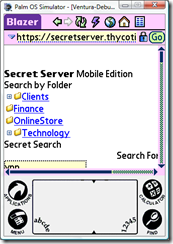
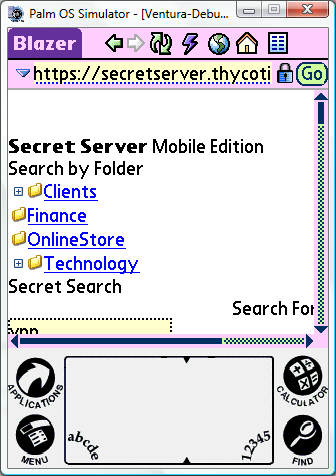
Today we had a customer ask about the Treo 700 so I tried out the emulator from the Palm website.  It seems to work fine with Secret Server and I was able to browse around and access passwords.

Do your web applications support mobile devices and if so how do you test them?

Jonathan Cogley is the CEO and founder of Thycotic Software, a .NET consulting company and ISV in Washington DC.  Our product, Secret Server is a enterprise password manager system for teams to secure their passwords.  Is your team still storing passwords in Excel?

A sign that you are no longer a startup.
Thursday, April 10, 2008 11:20 PM
100_0455

Ok, so it is a really bad pun.  It is tough writing blog post titles sometimes. :)

Anyway, we finally got a beautiful metallic official sign for our office after inhabiting our office space for almost two years.  (Now if we could just do something about that door!). 


In our first office suite in Vienna (VA) we had a good excuse for not having a sign since it was shared space and we weren't allowed sign-age.

In our current space, we actually lasted almost two years with this paper sign.  Not exactly glamorous but it did the job.

100_0453

This got me thinking ... when is the moment that you are no longer a startup? 

A few facts about Thycotic's beginnings:

  • We were profitable from day one.
  • Our software development consulting business has always been a stable, profitable area.
  • On the product side, Secret Server is self funded, started small and has slowly built a solid customer base.
  • The company was officially formed in 1996 but only hired its first employee other than me in 2004.

So how do we identify a change from startup to mature company?
(if it is has even really happened to us yet)

Could it be?

  • The day you finally turn off the email that tells you when someone bought your product.
  • The day the founder can take more than one consecutive week of vacation.
  • The day you don't know how many employees are in the company (this has already happened but that is just because I have a hard time figuring it out on the fly).
  • The day that the company hires someone the founder didn't hire or even meet.
  • The day you walk by someone in the hall you have seen often but have no idea who they are.
  • The day you are bought out by some monster corporation. (assuming you want to be bought out ... which we don't)

What would you define as the tipping point?  In the meantime, we are going to continue admiring our new sign. :)


Jonathan Cogley is the CEO and founder of Thycotic Software, a .NET consulting company and ISV in Washington DC.  Our product, Secret Server is a enterprise password manager system for teams to secure their passwords.  Is your team still storing passwords in Excel?

Code Camps this weekend!
Thursday, April 10, 2008 10:54 PM

CodeCampLogo There are two code camps this weekend:

I will be speaking at the Pittsburgh Code Camp on Refactoring - a topic that is very dear to me.

Register now and come along to talk code.


We are hiring!  Do you want to write beautiful code in a Test Driven, Refactored, Agile .NET software company in the heart of Washington DC and work on cool products?  Take the code test and send your resume along with why you want to join Thycotic to tddjobs@thycotic.com.

When you apply for a job, read the job posting!
Monday, April 07, 2008 10:48 PM

I am constantly amazed by the number of job candidates who apply for a position without reading the job posting.  We are currently hiring for three positions: 

  • Agile .NET Developer
  • Agile .NET Developer Internship
  • Graphics Designer

All three involve *doing* something in order to be considered for the position - for the developer positions it requires completing a code sample and sending it in with your resume.  For the graphics designer position, it requires putting together a fun design and sending it in with resume.

image I have not kept accurate numbers (since we have run the postings for a while now with lots of applicants) but roughly 1 out 2 candidates for the developer positions and a whopping 4 out of 5 candidates for the graphics designer position do not submit their design/code.  If I receive 20 applications in two days and your application is canned and does not include the design/code - then guess what happens to yours? ... it gets DELETED.  Can you believe that there are many applicants who just send a resume without even a cover letter?

If you can't bother to read a job posting, why do you expect someone else to bother reading your resume?

It is truly amazing that some people believe their resume alone will make them stand out - I imagine many companies don't even open the resume if the applicant hasn't met the requirements of the job posting - I know we don't.

A job is an significant part of our lives and should be treated with importance.

When you next apply for a job:

  1. Read the job posting entirely.
  2. Submit any additional samples/code as required.
  3. Research the company, understand what they do and why you might want to work there.
  4. Write a good cover letter explaining what you find interesting about the company, team or position.

Take these simple steps and you will stand out.

We are hiring!  Do you want to write beautiful code in a Test Driven, Refactored, Agile .NET software company in the heart of Washington DC and work on cool products?  Take the code test and send your resume along with why you want to join Thycotic to tddjobs@thycotic.com. (don't forget to read the job posting! :))

Secret Server at FOSE 2008
Thursday, April 03, 2008 9:59 PM

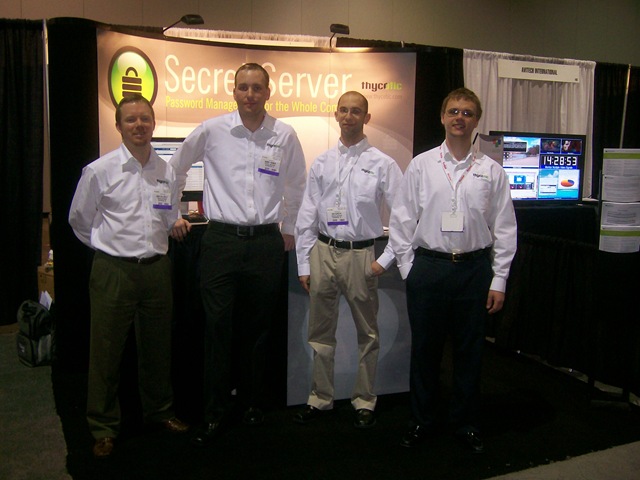
Jonathan, Dan, Ken and Kevin, Eddie (absent today) We took the Secret Server booth to the FOSE 2008 Conference this week.  FOSE is the largest IT event for US Government.  It wasn't really a very long trip for us ... about 12 blocks east from our offices in Dupont Circle in Washington DC to the DC Convention Center. :)

This was a very different conference for us since the audience varied widely in their roles compared to a conference such as Microsoft TechEd.  We met lots of IT managers and also our core audience of System Administrators and Network Administrators.  If you have an Excel spreadsheet of passwords that you share across your team ... then Secret Server is a no brainer for you.

My favorite part of tradeshows is hearing where your product falls short and learning to better understand your customer's needs.  Secret Server has come a long way in the last year and most the requests we heard were already met within the product.

The next stop for the Secret Server booth will be the Microsoft TechEd 2008 Conference (IT Pro week) in Orlando, Florida in June.  If you are going, please stop by our booth to say hi.


Jonathan Cogley is the CEO and founder of Thycotic Software, a .NET consulting company and ISV in Washington DC.  Our product, Secret Server is a enterprise password manager system for teams to secure their passwords.  Is your team still storing passwords in Excel?

More Posts

This Blog

Syndication