Archives
-
Microsoft vs TestDriven.NET - 31 May 2007
I have just received another courier delivered letter from Microsoft's lawyers. That makes a total of 3 letters in 4 working days! I can see how these things can get expensive very quickly.
-
Microsoft vs TestDriven.Net Express
There are a few things I need to get off my chest.
-
Microsoft Lawyers - Chapter 3
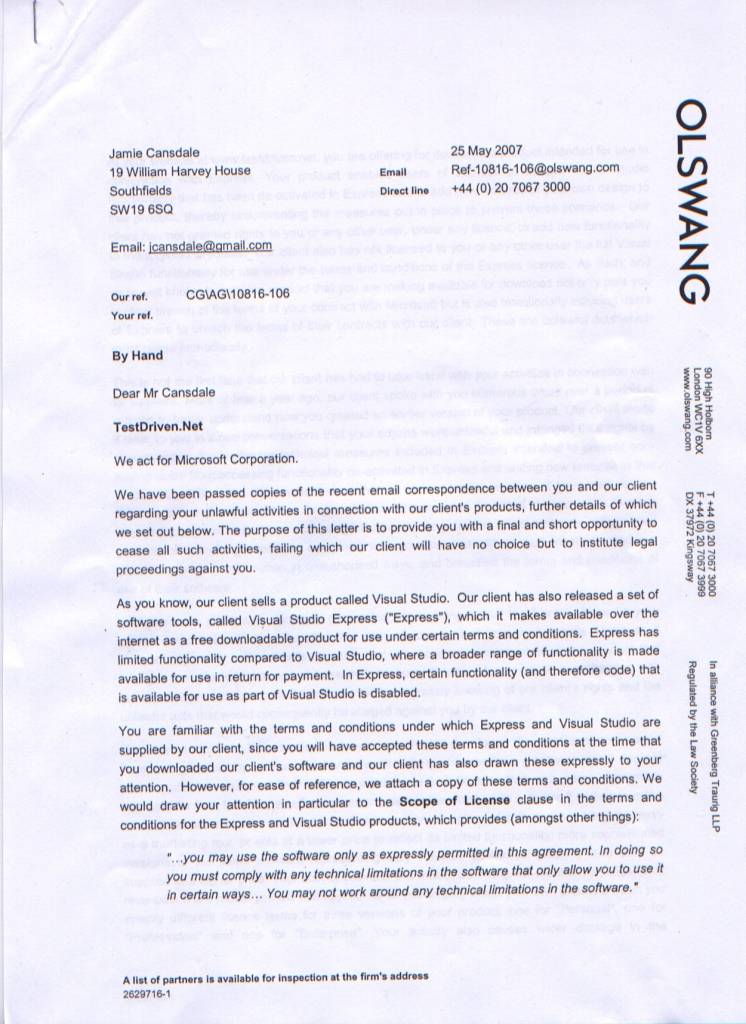
-
Microsoft Emails - Chapter 2
From: Jason Weber
To: Jamie Cansdale
Cc: Grant Drake
Sent: Friday, March 31, 2006 5:24 PM
Subject: Follow-up Information

Hello Jamie and Grant,

Thank you for taking the time to talk with Craig and myself yesterday. I
believe that we're making forward progress and look forward to a rapid
resolution. Below are the links to our VSIP programs, technical benefits
package, and general information that I promised to send.

The Visual Studio extensibility site can be found here:
http://msdn.microsoft.com/vstudio/extend/

After becoming an Affiliate (free) member you can download the Visual
Studio SDKs from here. We're about to ship the v2 Visual Studio SDK
which provides Iron Python tools, improved language integration
frameworks, Team Foundation Server integration libraries and
documentation, and lots of other improvements. We release CTP's of the
SDK every month and a full SDK about every four months. We welcome your
feedback!
https://affiliate.vsipmembers.com/login.aspx?err=cannot_find_user

You can find information about joining the VSIP program here. Our next
developer lab is April 10th-14th and we have over 100 VSIP partners
attending from around the world. These devlabs would provide you with
opportunities to work with our engineers to better integration your
products into the Visual Studio Standard+ product family.
http://msdn.microsoft.com/vstudio/partners/

As an Alliance and Premier VSIP partner you receive benefits ranging
from an MSDN subscription, to paid product support incidences, to
co-marketing opportunities. These are the opportunities that Craig
discussed yesterday and include discounted booths at tradeshows,
inclusion in our online catalogs, placement in the annual "Visual Studio
Technologies" booklet, discounts on direct mailings through MSDN flash,
announcements via the Visual Studio Start Page, and other opportunities.
If you would like to purse these opportunities please contact the team
through this website.
https://affiliate.vsipmembers.com/partnerengagement.aspx

Finally the partner catalog can be found here:
http://catalog.vsipmembers.com/catalog/

Please let us know how you would like to proceed!

Sincerely, Jason Weber
Group Program Manager
Visual Studio
425.882.8080


Form: Jamie Cansdale
To: Craig Symonds
Date: Apr 7, 2006 1:11 AM
Subject: Moving Forward with TestDriven.NET

Hi Craig,

I'm glad we were able to have a frank discussion about TestDriven.NET
and its integration into the various Visual Studio SKUs. Over the last
few days I have been giving serious consideration to what you said and
to the various positive ways forward that we could follow.

I am certainly interested in pursuing the type of marketing-based
partnership that Microsoft currently offers to enterprise ISVs through
the VSIP program. However, I would also like to explore the
possibility of buiding a closer, more technology-based partnership.

In my opinion, there are two particular areas where such a partnership
could be of real value to Microsoft and TestDriven.NET. One is to
bring light-weight MSTest compatible unit-testing support to the
Standard SKU. The other is enabling support for alternative
unit-testing frameworks in SKUs that include the full MSTest
functionality.

Bringing light-weight MSTest compatible unit-testing to the Standard
SKU would resolve the current dilemma faced by many teams inside
Microsoft who want to make their unit-tests publicly available. At the
moment the choice is between using MSTest which restricts the target
audience to users of the Team SKUs and NUnit which is available on all
SKUs but isn't a Microsoft technology.

Enabling support for alternative unit-testing frameworks by building
on the MSTest functionality is something I have already made good
progress on. However I was frustrated by certain limitations that
restrict how deep the integration could go. As I mentioned during the
teleconference, helping customers with a large number of preexisting
NUnit tests migrate to VSTS is one of the pain points TestDriven.NET
aims to address. The customers I am most keen to target are
enterprises who are currently using VS2003 (or even VS2002) who at
some point will make the migration to VS2005. TestDriven.NET is all
about making this migration less intimidating.

I look forward to hearing what you think.

Regards,
Jamie.


From: Jason Weber
To: Jamie Cansdale
Cc: Grant Drake
Date: Apr 11, 2006 6:37 AM
Subject: RE: Follow-up Information

Hello Jamie,

It has been 10 days since we spoke. Have you decided how you would like
to proceed? We look forward to your support in quickly resolving this
matter.

Thank you!

Jason Weber
Group Program Manager
Visual Studio


Form: Jamie Cansdale
To: Ben Miller
Date: Apr 11, 2006 11:32 AM
Subject: Changing Specialty

Hi Ben,

I notice that I'm no longer an MVP for ASP.NET. At the end of last
year Jason Weber forwarded my details to Mark Colburn, recommending me
as an MVP for Visual Studio Extensibility. I was wandering if you
would mind contacting Mark to see how this is progressing. I'd would
hate to lapse as an MVP for this season!

On 12/8/05, Jason Weber wrote:
>
> 4.) I've sent your name to Mark Colburn, the program manager who drives
> our Visual Studio ecosystem team. Mark is looking for Visual Studio
> Extensibility MVP's, and as we discussed I believe you would be a great
> addition to the program, and it would be much more applicable than your
> current ASP.Net MVP involvement. Please look for mail from Mark in the
> coming months.

Thanks, Jamie.


Form: Jamie Cansdale
To: Jason Weber
Cc: Grant Drake
Date: Apr 11, 2006 11:54 AM
Subject: Re: Follow-up Information

Hi Jason,

Sorry I haven't replied to you sooner. I have actually already
contacted Craig with some suggestions that go beyond the scope VSIP.
It is still very much at the preliminary stage of discussion. I'll
keep you posted once something more concrete has been agreed. I'm
optimistic that things are moving in the right direction and that
we'll find a satisfactory resolution.

Regards,
Jamie.


From: Jason Weber
To: Jamie Cansdale
Cc: Grant Drake
Date: Apr 11, 2006 3:17 PM
Subject: RE: Follow-up Information

Jamie,

I manage the Visual Studio Ecosystem product team and will be your
primary point of contact at Microsoft. Your call with Craig was out of
courtesy so that you could discuss with a Microsoft executive and better
understand our position. If you have suggestions please work directly
with me. I look forward to see your proposal.

Thanks - jason


Form: Jamie Cansdale
To: Jason Weber
Cc: Grant Drake
Date: Apr 13, 2006 1:18 AM
Subject: Re: Follow-up Information

Hi Jason,

I'm glad we were able to have a frank discussion about TestDriven.NET
and its integration into the various Visual Studio SKUs. Over the last
few days I have been giving serious consideration to what you said and
to the various positive ways forward that we could follow.

I am certainly interested in pursuing the type of marketing-based
partnership that Microsoft currently offers to enterprise ISVs through
the VSIP program. However, I would also like to explore the
possibility of buiding a closer, more technology-based partnership.

In my opinion, there are two particular areas where such a partnership
could be of real value to Microsoft and TestDriven.NET. One is to
bring light-weight MSTest compatible unit-testing support to the
Standard SKU. The other is enabling support for alternative
unit-testing frameworks in SKUs that include the full MSTest
functionality.

Bringing light-weight MSTest compatible unit-testing to the Standard
SKU would resolve the current dilemma faced by many teams inside
Microsoft who want to make their unit-tests publicly available. At the
moment the choice is between using MSTest which restricts the target
audience to users of the Team SKUs and NUnit which is available on all
SKUs but isn't a Microsoft technology.

Enabling support for alternative unit-testing frameworks by building
on the MSTest functionality is something I have already made good
progress on. However I was frustrated by certain limitations that
restrict how deep the integration could go. As I mentioned during the
teleconference, helping customers with a large number of preexisting
NUnit tests migrate to VSTS is one of the pain points TestDriven.NET
aims to address. The customers I am most keen to target are
enterprises who are currently using VS2003 (or even VS2002) who at
some point will make the migration to VS2005. TestDriven.NET is all
about making this migration less intimidating.

I look forward to hearing what you think.

Regards,
Jamie.


From: Jason Weber
To: Jamie Cansdale
Cc: Grant Drake
Date: Apr 13, 2006 5:52 AM
Subject: RE: Follow-up Information

Hi Jamie,

I believe that both of your ideas hold great potential and we would be
delighted to see you pursue either/both opportunities. You are permitted
to extend the Visual Studio devenv based SKU's (Std/Pro/VSTS) with
whatever features you like. Many VSIP partners provide higher end
features on the Visual Studio Std product line so you would be following
a well know business model.

Do you have a specific ask of Microsoft?

Thanks - jason


Form: Jamie Cansdale
To: Jason Weber
Date: Apr 17, 2006 11:58 PM
Subject: Re: Follow-up Information

Hi Jason,

One of the key differentiators TestDriven.NET has from other unit
testing add-ins is its support for multiple unit testing frameworks.
My plan is to leverage this by providing a bridge between VSTS and the
various supported frameworks. There is also an opportunity to bring
light weight MSTest compatible unit testing to all devenv based SKUs.

In our tele-conference, Craig mentioned that Microsoft plans to
introduce testing support to the Orcas Pro SKU. What I would really
like to know is how would being able to offer MSTest compatible unit
testing support via a VSIP partner's add-in fit with Microsoft's
strategy? The scenario I have in mind is when a team inside Microsoft
releases unit tests with their sample code (for example the VS SDK,
PAG Enterprise Library and MSBee all include unit tests). At the
moment these unit tests are only really useful to Team SKU users. By
partnering with TestDriven.NET, Microsoft could offer users who don't
have access to the Team (or in future Orcas Pro) SKUs an alternative.

In order to support MSTest compatible unit testing I would need
permission to distribute the following assemblies with TestDriven.NET.

Microsoft.VisualStudio.QualityTools.UnitTestFramework.dll
Microsoft.VisualStudio.QualityTools.Resource.dll

Note, I'm not asking for these assemblies to be made generally
redistributable (included in REDIST.TXT). It is in the interest of
TestDriven.NET for people to use Visual Studio for their unit testing
needs (rather than an alternative IDE or standalone application).

Apart from this specific request, I would also like the opportunity to
work with the VSTS team to ensure I can offer a great legacy unit
testing bridge for the Orcas Pro/Team SKUs.

I was also wondering if you could ping Mark Colburn about me changing
MVP specialty to Visual Studio Extensibility. I never heard back from
him after you suggested this as the end of last year.

Thanks, Jamie.


From: Jason Weber
To: Jamie Cansdale
Date: Apr 18, 2006 2:56 AM
Subject: RE: Follow-up Information

Thank you for your thoughts Jamie.

At some point in the future Microsoft may decide to change our SKU
features and ship unit testing in Pro or even Standard products, but
it's to early to know if that will take place in Orcas. Microsoft would
be happy to partner with you through the VSIP program to help make our
millions of developers aware of your unit testing technologies. We have
several companies who are offering unit testing scenario tools
integrated into Visual Studio and would love to include you among that
list. In fact last week at the quarterly VSIP developer lab there was a
new startup who was building unit testing tools into the full suite and
my team spent a full week helping them!

The VSTS team supports customers at the VSIP developer labs and I'm sure
they would be happy to provide you architectural and integration
guidance, help you understand our product offering, and help debug any
integration blockers. The VSIP program is our standard model for
engaging with Visual Studio partners like yourself, and I believe it
would be in your best interest to engage through this program so that
you can receive the full spectrum of benefits.

Unfortunately we can't give you permission to redistribute these VSTS
components for use in the Visual Studio Standard and Pro SKU's. There
are technically challenges (servicing, deployment, IA's, etc.) not to
mention business challenges (need to license to all VSIP partners, would
have to restrict scenario, etc.). Today we don't allow anyone partner to
change our SKU lineup.

As you know your MVP affiliation was not renewed this year. Based on
your current actions and community participation rate I can't award you
MVP status. I hope that you will harness your Visual Studio
extensibility passions and earn VSIP MVP status over the coming year by
integrating through public API's and supporting our community.

Also, I should let you know that almost everyone you and James Avery
have emailed work for me. My team is aware of our discussions and
they've been asked to direct your communications to me.

Thank you - jason
[The only person I emailed was Ben Miller]
[James Avery emailed Josh Ledgard in Dec 05]
Form: Jamie Cansdale
To: Jason Weber
Date: Apr 21, 2006 12:25 AM
Subject: Re: Follow-up Information
Hi Jason,
I appreciated your honesty concerning my MVP status and the part you
played in not renewing my award. There is one other thing that I need
to be completely clear on. Are you saying that if I disable Express
SKU support Microsoft will offer me VSIP Premier partnership (if so,
for how long?) or are you saying that if I don't disable Express SKU
support I will be barred from joining any VSIP program?
Should we eventually work together within the context of the VSIP
program, I can see that there would be some interesting possibilities.
When the Express SKU support is disabled, I will obviously need to
point users towards the SKU that was really intended for them. If I
was eligible to license and distribute Visual Studio, I could make
this available from the TestDriven.NET website.
Regards,
Jamie.
From: Jason Weber
To: Jamie Cansdale
Date: Apr 21, 2006 2:26 AM
Subject: Visual Studio Express Integration
Jamie,
We haven’t made forward progress over the past month and your
delayed email responses lead me to question your commitment towards
reaching an amicable solution. As we have discussed on multiple
occasions your hacks to integrate TestDriven.Net into Visual Studio
2005 Express violate Microsoft license terms and we ask that you
stop distributing these hacks.
As we have discussed since December Jamie, we would like to see you
harness your passions around TDD and build extensions to the Visual
Studio Standard, Professional, and VSTS products. By joining the
Microsoft Visual Studio Industry Partner Program and integrating
through supported mechanisms you will receive countless marketing,
business, and technical benefits that will help your products be
successful. The full benefits package can be found here:
http://msdn.microsoft.com/vstudio/partners/
If you have any questions please don’t hesitate to contact me.
Jason Weber
Group Program Manager
Visual Studio
Microsoft Corporation
One Microsoft Way
Redmond, WA 98052
Phone 425.882.8080
Please let me know when your integration has been removed from
your website.
Thank you! - Jason
Form: Jamie Cansdale
To: Jason Weber
Cc: Grant Drake
Date: Apr 22, 2006 1:37 AM
Subject: Fwd: Follow-up Information
Hi Jason,
I think you may have missed my email. I remain totally committed to
reaching an amicable solution. I'm sure we could move forward in a way
that is constructive for everyone. Please can we start building
bridges and move on!
Regards, Jamie.
From: Jason Weber
To: Jamie Cansdale
Cc: Grant Drake
Date: Apr 22, 2006 3:16 AM
Subject: RE: Follow-up Information
Jamie,
I would much prefer that we reached an amicable solution, but I don't
feel that we're trending in that direction. I had already replied to
this email. To ensure that we're on the same page let me explicitly
answer your requests:
1.) We will not allow you to redistribute VSTS unit testing components
with your product for use in Standard/Pro SKU's.
2.) We will not allow you to redistribute Visual Studio below Select B
pricing (our standard pricing model).
3.) We are not offering you a free VSIP Premier, Open Tools and/or IDE
redistribution partnership.
4.) We will not allow you to extend the Visual Studio Express SKU's
under any conditions.
5.) You will not be accepted into the VSIP program until you conform to
our license agreements.
To be clear Microsoft is not going to compensate you for discontinuing
your Express extensions. We are willing to work with you through the
VSIP program once you are in conformance with our license terms. That
said we are willing to entertain any other suggestions you might have.
Thanks - jason
Form: Jamie Cansdale
To: Jason Weber
Cc: Grant Drake
Date: Apr 23, 2006 2:04 PM
Subject: Re: Follow-up Information
Hi Jason,
Thank you for spelling out Microsoft's position so clearly. I find
this directness constructive and feel that we're moving forwards. In
this same spirit I would like to lay out my position:
1.) All of the interfaces and methods I used to extend the Express SKU
are public and documented on the MSDN website.
2.) I have sought legal advice on the Express SKU EULA and as far as
my lawyer is aware I am not in breach of the licence.
In our second teleconference Ben Miller told me this issue would not
impact my MVP status or prospects for renewal (baring Microsoft taking
legal action). I feel a constructive way forward would be if Microsoft
were to make a gesture of good faith by renewing my MVP award for this
season. I would then be happy to remove Express SKU integration from
my website and engage with Microsoft through the VSIP program as you
have suggested.
To be clear I am not asking to be made a VSIP MVP as compensation for
discontinuing my Express SKU extensions. I am simply asking not to be
punished over an issue that everyone would like to move away from.
Assuming we can agree upon this as an amicable way forward, I will
publish the following installer on my website:
http://www.mutantdesign.co.uk/downloads/TestDriven.NET-2.1.1586_Basic.zip
Regards, Jamie.
From: Jason Weber
To: Jamie Cansdale
Cc: Grant Drake
Date: Apr 23, 2006 8:14 PM
Subject: RE: Follow-up Information
It's good to see a realistic solution on the table. Unfortunately your
community participation rate over the past year (in any of the
communities including VSIP and ASP.Net) is well below the required
level. Even if we were to look beyond the MVP code of conduct concerns I
don't believe we could justify reinstating you based on participation.
We have thousands of customers trying to earn their way into our MVP
program and it's important that we maintain a level playing field based
on contribution.
What specific benefits of the MVP program are you interested in? There
may be a way that I can help you out in good faith. I want to find a
win/win resolution.
Form: Jamie Cansdale
To: Jason Weber
Cc: Grant Drake, Ben Miller
Date: Apr 24, 2006 2:04 AM
Subject: Re: Follow-up Information
Hi Jason,
It is only really the community aspect that I'm concerned about. I am
pretty well known within the MVP community and I don't want to end up
explaining to everyone why I wasn't renewed this year. That wouldn't
help me move on.
I think you maybe underestimate my participation rate. I admit it has
been hampered somewhat by this ongoing situation. Perhaps you could
take into account the contributions I didn't make as well as the ones
I did. ;o)
At this stage I can't think of any other way to reach truly amicable
solution. You know my position on the Express SKU licence. The threat
of legal action isn't going to move this forward. All I'm asking for
is a VSIP MVP lead than I can engage with constructively over the
coming weeks. Pulling an add-in that many people enjoy using will
inevitably create a delicate situation that may need to be managed.
I'm proposing that we work together on this. Does that make sense?
Regards, Jamie.
Form: Jamie Cansdale
To: Jason Weber
Cc: Grant Drake, Ben Miller
Date: May 2, 2006 12:19 PM
Subject: Re: Follow-up Information
Hi Jason,
I'm planning to release a new version of TestDriven.Net this week. I
was wondering if you have had any further thoughts on this?
Regards, Jamie.
Form: Jamie Cansdale
To: Jason Weber
Cc: Grant Drake, Ben Miller
Date: May 6, 2006 9:50 AM
Subject: Re: Follow-up Information
Jason,
I have just uploaded a new version of TestDriven.Net. For what it's
worth I have removed Express SKU integration. I am now depressed and
left feeling burnt by this whole sorry affair. Don't be surprised if
this is the last version of TestDriven.Net.
Regards,
Jamie.
Form: Jamie Cansdale
To: Jason Weber
Date: May 11, 2006 9:11 PM
Subject: Re: Visual Studio Express Integration
Hi Jason,
I'm curious to know what the difference between Premier Marketing and
Premier Partner Edition membership is. They both cost $10,000/year but
Premier Partner Edition appears to be a superset of Premier Marketing.
Am I missing something?
Thanks, Jamie.
From: Jason Weber
To: Jamie Cansdale
Date: May 12, 2006 11:02 PM
Subject: RE: Visual Studio Express Integration
Premier Partner Edition provides you the ability to redistribute
Microsoft technologies, such as the Visual Studio PPE, our compilers,
linkers, etc. at fixed prices and is a superset of the Premier Marketing
agreement. Many of our partners don't need to redistribute Microsoft
technologies and the legal terms around redistribution add several pages
to the Premier agreement, so we provide the Premier Marketing agreement
to those customers for convenience.
Thank you for not registering your project extender during installation
and turning off your hacks by default. It appears that by setting a
registry key your hacks can still be enabled. When do you plan to remove
the Visual Studio express hacks, including your addin activator, from
you product.
Thank you! - Jason
Form: Jamie Cansdale
To: Jason Weber
Date: May 13, 2006 2:14 PM
Subject: Re: Visual Studio Express Integration
Hi Jason,
The only reason I left the addin activator in was so that I could
continue testing a Team SKU alongside a non-Team SKU on my own
development machine. To create the registry key necessary to add
Express SKU integration, someone would need to know exactly what they
were aiming for (as your developers obviously do). I had no intention
of showing bad faith and leaking this information!
You obviously want me to remove the addin activator component so I
have done (see the latest build). If you have any idea how I could run
the Std and Team SKUs side by side, I would be grateful if you could
let me know. I would rather not resort to using a separate machine or
VM for each SKU.
Thanks, Jamie.
From: Jason Weber
To: Jamie Cansdale
Date: May 13, 2006 5:59 PM
Subject: RE: Visual Studio Express Integration
Thanks for removing the activator Jamie!
What do you mean by running the Standard and Team SKU's SxS? When these
SKU's are installed on the same machine they compose together into a
single instance of Visual Studio (using the devenv AppID). For a SKU to
run SxS it needs its own AppID like the Visual Studio Express SKU's.
If you help me understand your scenario I'm sure we can find a
workaround for you.
Thanks - jason
Form: Jamie Cansdale
To: Jason Weber
Date: May 13, 2006 9:12 PM
Subject: Re: Visual Studio Express Integration
Hi Jason,
The problem I have is that TestDriven.Net behaves differently
depending on whether it's running on the Team SKU or one of the lower
SKUs. When I install Standard and Team at the same time they compose
together to form something that is indistinguishable from just Team.
This means I can no longer check how TestDriven.Net behaves when
running on the Standard SKU.
I hope I'm wrong here, but I don't think it's possible to install the
devenv based SKUs using a different AppID and registry root. I know
devenv /rootsuffix can get me close, but whatever I put under the new
registry root - DTE.Edition still comes back as "Enterprise".
Hopefully there is some other trick that will do what I'm looking for.
Thanks, Jamie.
From: Jason Weber
To: Jamie Cansdale
Date: May 13, 2006 9:37 PM
Subject: RE: Visual Studio Express Integration
Ah, I see what you're doing! Whether good or bad this is by design and
there's no easy work around. For development purposes you could do
something like have your own registry key that exerts your Standard code
path.
For testing purposes though I would highly recommend using VM's. The
only way to safely test Standard is on a machine that doesn't have
binaries from higher SKU's installed. This will help you catch scenarios
where you're using API's that aren't installed on Std. This is how we
test Visual Studio and our aftermarket VSPackages internally and the
only reliable approach.
Later - Jason
Form: Jamie Cansdale
To: Jason Weber
Cc: Ben Miller, Lorna Williamson
Date: Feb 22, 2007 12:19 AM
Subject: Re: Visual Studio Express Integration
Hi Jason,
In our teleconference last year with Ben an Lorna you mentioned 3 ways
in which you believed I may be in breach of Microsoft's license terms.
On this basis that Ben requested that I comply and take down support
for the Express SKU's.
1) You said that by using Intellisense I may be in breach of the
dissasembly clause in the VS SDK license.
2) You said that by working out how to use an API by looking at the
public type and method names I may be in breach of the reverse
engineering clause in the VS SDK license.
3) You said that by adding a button to the Express SKU interface I may
be in breach of Microsoft's copyright.
After the teleconference I said that I would need a statement that I
could give to my users about why the Express SKU was no longer
supported. I continue to get emails asking why TestDriven.NET no
longer works with Express. Please can you confirm that the points
above are why you believe I was in violation.
Regards,
Jamie.
Form: Jamie Cansdale
To: Jason Weber
Cc: Ben Miller
Date: Feb 26, 2007 10:37 AM
Subject: Re: Visual Studio Express Integration
Jason,
Your delayed response leads me question whether you ever had
reason to believe I was in violation of Microsoft's license terms. If this
is not the case I request that you let me know immediately. Any further
delay will lead me to re-enable Express SKU support without notice.
Regards,
Jamie.
From: Jason Weber
To: Jamie Cansdale
Cc: Ben Miller;Lorna Williamson
Date: Feb 26, 2007 9:30 PM
Subject: Re: Visual Studio Express Integration
Jamie, for the reasons we discussed at great length, we believe your
various extensions to the Visual Studio Express products necessarily
violated the relevant license terms. We don't think it's productive to
rehash those discussions. Instead, we encourage you to focus your
energies on legitimately extending the Visual Studio products, as
permitted under the Visual Studio Industry Partner (VSIP) program and
the associated terms and conditions.
Thank you, Jason Weber
From: Vicki Collins
To: Jamie Cansdale
Cc: Akim Boukhelif;Lorna Williamson
Date: Feb 27, 2007 11:06 AM
Subject: Microsoft Most Valuable Professional Award
Hello Jamie,
My name is Victoria Collins; I'm a member of the Microsoft(r) Most
Valuable Professional (MVP) team for UK & Ireland with Lorna
Williamson and Akim Boukhelif. I'm contacting you to ask if you would
like to be considered for an MVP Award in recognition of your
contributions to technical communities over the past year.
MVPs are recognized by Microsoft for their voluntary participation in
offline and online technical communities. If you are not familiar with
the MVP program you can learn more by visiting our web site at:
http://mvp.support.microsoft.com.
Our web site includes a Frequently Asked Questions (FAQ) section which
provides answers to questions commonly asked about the MVP program and
also provides a lot of good information describing the program
(http://mvp.support.microsoft.com/mvpfaqs). For your reference, I
have posted the top 4 FAQs at the bottom of this e-mail.
We are considering you for this award because you have been
recommended to us due to your extensive online work within the Visual
Developer .NET communities. In order for me to get to know you better,
would you mind sharing with me some additional details about your
participation in the online communities during the past year and any
other contributions you might have made to the community, by filling
in the attached "community activities" excel spreadsheet. Please
include as much detail as possible (for example: links, total number
of web site visitors, total number of online publications or books
sold)
Responding to this e-mail and to the questions in the spreadsheet is
completely voluntary. If you prefer to not respond, your nomination is
not affected and you are still under consideration for an MVP Award.
If you have questions about the MVP Program, your nomination, or this
e-mail, please e-mail me or telephone Akim Boukhelif on +44 (0) 118
909 5132 at your convenience.
Currently you are still under consideration for a Microsoft MVP Award.
If you are successful, you will be awarded your MVP status on July 1st
2007.
Thank you,
Vicki Collins
UK & Ireland MVP Administrator
The Microsoft MVP Programme: Independent Experts. Real World Answers
From: Vicki Collins
To: Jamie Cansdale
CC: Akim Boukhelif;Lorna Williamson
Date: Fri, 2 Mar 2007 20:11:43 +0000
Subject: Recall: Microsoft Most Valuable Professional Award
Vicki Collins (Brook Street) would like to recall the message,
"Microsoft Most Valuable Professional Award".
From: Jason Weber
To: Jamie Cansdale
Date: Apr 17, 2007 5:24 PM
Subject: RE: Visual Studio Express Integration
Jamie,
We just noticed that you recently re-enabled extensions to our Visual
Studio Express products:
http://weblogs.asp.net/nunitaddin/archive/2007/04/02/express-sku-support.aspx
This is extremely disappointing. We spent a lot of time last year
explaining to you, over a period of many months, that our Express
products are not designed or intended to be extensible. As we also
explained to you many times, our license terms for the Express
products do not permit extending them with new functionality or by
enabling access to latent Visual Studio functionality that we
purposely de-activated for our Express products. Your various
extensions, in both their former and current incarnations, necessarily
violate those license terms and infringe our rights in our products.
You are also putting your own customers in a difficult position, since
you are encouraging them to breach the license terms, too.
We thought that you ultimately recognized this, when you withdrew
support for Express from your products last year. We can't help but
conclude that, by re-enabling Express support now, in light of all of
our conversations (including the email exchange below in February),
you have consciously decided to flout our rights.
What makes this especially puzzling is that you are undermining the
economic model that you rely on for your own products. Nearly all
software vendors offer limited versions of their products for nominal
or no cost, often as a marketing or entry-level tool. More
sophisticated or feature-rich versions of the same software are then
supplied at a higher price. We do this with Visual Studio Express (our
free products) and Visual Studio Standard and above (our commercial
products). You use this model for your own products, the "Personal,"
Professional" and "Enterprise" versions of TestDriven.NET. Your
actions subvert the model that we all rely on.
Instead of extending Express, I'd urge you again to focus your energy
and talents on extending our commercial Visual Studio products, under
the terms of our publicly available VSIP program. Hundreds of other
partners are successfully doing this, all the while respecting the
restrictions on extending the Express products. There's no reason why
TestDriven.NET can't be successful doing this, too.
We'd really like to resolve this amicably. Please remove support for
our Express products from your software as soon as possible. Please
also let me know when you have done this, and confirm that you will
not make such support available in the future. If you do not remove
support by that date, then this matter will be out of my hands and I
will have to turn this over to the lawyers. I really hope it does not
come to that.
Thank you, Jason Weber -
Microsoft Emails - Chapter 1
From: Jason Weber
To: Jamie Cansdale
Date: Dec 1, 2005 11:05 PM
Subject: TestDriven.Net VSIP Package

Hi Jamie,

My name is Jason Weber and I’m the lead for the Visual Studio IDE and
Visual Studio SDK. I work closely with many of our VSIP partners on
their integration, and was pointed toward TestDriven.Net last week.
You’ve done a great job with your Visual Studio integration and I was
wondering if you had time for a 30 minute conference call next
Wednesday. I wanted to better understand your product and strategy.

Thanks – Jason Weber


From: Jason Weber
To: Jamie Cansdale
Date: Dec 8, 2005 7:34 AM
Subject: Follow-up Information

Hi Jamie,

Thanks for taking the time to meet with me today. I just downloaded your
product and I'm going to play around tonight. I enjoyed our conversation
and wanted to send links to the information we discussed today.

1.) The Visual Studio extensibility site can be found here:
http://msdn.microsoft.com/vstudio/extend/

2.) After becoming an Affiliate member you can download the Visual
Studio SDKs from here. You will find our new mock objects in the latest
CTP.
https://affiliate.vsipmembers.com/login.aspx?err=cannot_find_user

3.) You can find information about joining the VSIP program here. Our
next developer lab will be in the spring of next year, and all VSIP
partners will have the opportunity to attend.
http://msdn.microsoft.com/vstudio/partners/

4.) I've sent your name to Mark Colburn, the program manager who drives
our Visual Studio ecosystem team. Mark is looking for Visual Studio
Extensibility MVP's, and as we discussed I believe you would be a great
addition to the program, and it would be much more applicable than your
current ASP.Net MVP involvement. Please look for mail from Mark in the
coming months.

5.) Finally I've sent your contact information to the VSTS unit testing
team, and you should hear from them shortly after the holidays. They
sounded excited to work with you. If they don't contact you please let
me know and I'll ping them again.

Sorry to spring the bad news about the Express SKU's. I see that you
updated your build today. Did you already remove your hack? Man that was
quick ;-)


Take care, and good luck!
- jason


From: Jamie Cansdale
To: Jason Weber
Date: Dec 8, 2005 11:29 PM
Subject: Re: Follow-up Information

Hi Jason,

Thanks for the follow up. I look forward to hearing from Mark and the
VSTS unit testing team. I actually already know Noah Coad. I believe
he's one of the PMs on that team.

> Sorry to spring the bad news about the Express SKU's. I see that you
> updated your build today. Did you already remove your hack? Man that was
> quick ;-)
>
I'm quick, but not that quick. ;o)  I think you must have been caught
out by the time zone. I released something earlier on that day.

Is there any chance you could let me know which specific clause in the
licence I was contravening? I'm drafting an email to my users and
wanted to give them something concrete. I know a lot of people will be
disappointed.

Thanks, Jamie.


From: Jason Weber
To: Jamie Cansdale
Date: Dec 9, 2005 4:37 AM
Subject: RE: Follow-up Information

Since I'm not a lawyer I shouldn't comment on the license. However if
you read the Express SKU EULA you'll see verbiage around reverse
engineering, and if you read the VS SDK license (the license that covers
all native API's that you're accessing when you QueryService from your
add-in) you'll see additional terms that are relevant to your hack.
Sorry that I can't be more specific, but I'm just a developer ;-)

Later - jason


From: Jason Weber
To: Jamie Cansdale
Cc: Lorna Williamson, Ben Miller
Date: Dec 20, 2005 9:08 PM

Hi Jamie,

It's been two weeks since we last spoke. I wanted to send a quick mail
to see if you've had an opportunity to think through our previous
conversation (specifically about further integrating unit testing into
VSTS and also about your Express extension). I was hoping that we could
schedule a conference call for early January to answer any questions you
might have. I've included Lorna and Ben who would like to attend the
call. It would be appreciated if you could propose a date and time!

Thanks - jason


From: Jamie Cansdale
To: Jason Weber
Cc: Lorna Williamson, Ben Miller
Date: Dec 20, 2005 11:50 PM
Subject: Re: Follow-up Information

Hi Jason,

> It's been two weeks since we last spoke. I wanted to send a quick
> mail to see if you've had an opportunity to think through our previous
> conversation (specifically about further integrating unit testing into
> VSTS and also about your Express extension).
>
I have indeed been thinking about this. Obviously I am concerned about
the licence issue. However I think there may have been a
misunderstanding as to how my "hack" works. You mentioned my use of
QueryService to access the native APIs. I am in fact using the add-in
extensibility API and have intentionally not been touching the VSIP
interfaces.

To be on the safe side, I asked a friend who works as a lawyer in the
UK to go through the Express licence with me. In his opinion I'm not
in breach of anything as my technique didn't require any reverse
engineering or decompilation.

As things stand, I am reluctant to remove support for the Express SKU
as the reason for doing so is unclear and I would be unable to justify
it properly to my users (and to myself).

> I was hoping that we could schedule a conference call for early January
> to answer any questions you might have. I've included Lorna and Ben who
> would like to attend the call.
>
I would be happy to have another conference call. How does the 4th of
Jan sound, say 6PM GMT?

Thanks, Jamie.


From: Jason Weber
To: Jamie Cansdale
Cc: Lorna Williamson, Ben Miller
Date: Dec 21, 2005 7:21 AM
Subject: RE: Follow-up Information

We should certainly talk through your integration again Jamie to ensure
we're on the same page. As a precursor would it be possible for you to
send me the project references that you're linking to? I believe those
will expedite our discussions. I would be happy to discuss your
integration at the API level and help you understand what API's are
licensed under which licenses.

The 4th of January at 6PM GMT (10AM PST) works great. I will send a
meeting request.

I'm officially on vacation until the 4th of January but will
occasionally check email.

Happy Holidays! - jason


From: Jamie Cansdale
To: Jason Weber
Cc: Lorna Williamson, Ben Miller
Date: Jan 3, 2006 2:58 PM
Subject: Re: Follow-up Information

Hi Jason,

> As a precursor would it be possible for you to send me the project references
> that you're linking to? I believe those will expedite our discussions.
>
When compiled with Visual C# Express installed, the following
assemblies are referenced:
C:\Program Files\Common Files\Microsoft Shared\MSEnv\PublicAssemblies\envdte.dll
C:\Program Files\Common Files\Microsoft
Shared\MSEnv\PublicAssemblies\extensibility.dll
C:\Program Files\Common Files\Microsoft
Shared\MSEnv\PublicAssemblies\Microsoft.VisualStudio.CommandBars.dll
C:\Program Files\Common Files\Microsoft Shared\MSEnv\PublicAssemblies\stdole.dll
C:\Program Files\Common Files\Microsoft
Shared\MSEnv\PublicAssemblies\VSLangProj.dll
C:\WINDOWS\assembly\GAC\Microsoft.VisualStudio.OLE.Interop\7.1.40304.0__b03f5f7f11d50a3a\Microsoft.VisualStudio.OLE.Interop.dll
C:\WINDOWS\assembly\GAC\Microsoft.VisualStudio.Shell.Interop.8.0\8.0.0.0__b03f5f7f11d50a3a\Microsoft.VisualStudio.Shell.Interop.8.0.dll
C:\WINDOWS\assembly\GAC\Microsoft.VisualStudio.Shell.Interop\7.1.40304.0__b03f5f7f11d50a3a\Microsoft.VisualStudio.Shell.Interop.dll
C:\WINDOWS\Microsoft.NET\Framework\v2.0.50727\mscorlib.dll
C:\WINDOWS\Microsoft.NET\Framework\v2.0.50727\System.Data.dll
C:\WINDOWS\Microsoft.NET\Framework\v2.0.50727\System.dll
C:\WINDOWS\Microsoft.NET\Framework\v2.0.50727\System.Drawing.dll
C:\WINDOWS\Microsoft.NET\Framework\v2.0.50727\System.Windows.Forms.dll
C:\WINDOWS\Microsoft.NET\Framework\v2.0.50727\System.Xml.dll

I'm also referencing 'office.dll' and
'Microsoft.VisualStudio.QualityTools.UnitTestFramework.dll', which
come with Visual Studio .NET 2003 and Visual Studio 2005 Team Suite
respectively.

> I would be happy to discuss your integration at the API level and help
> you understand what API's are licensed under which licenses.
>
I thought it might help the discussion if we had some concrete code to
look at. I've put together an example extension that can be compiled
and used with only Visual C# Express installed. In a few places I've
added links to information about various APIs (see the TODO comments).
You can find the example code here:
http://www.mutantdesign.co.uk/downloads/ProjectReferences.zip

> The 4th of January at 6PM GMT (10AM PST) works great. I will send a
> meeting request.
>
Any word from Lorna and Ben?

> I'm officially on vacation until the 4th of January but will
> occasionally check email.
>
I'm sorry about the delay. I've been away on vacation as well.

Happy New Year!

Thanks, Jamie.


From: Jamie Cansdale
To: Jason Weber, Lorna Williamson, Ben Miller
Date: Jan 4, 2006 6:27 PM
Subject: Re: Discuss TestDrive.Net

Hi folks,

I thought it might be useful for people to have the licence(s) handy.
I've attached the Visual C# Express and Visual Studio SDK licences.

I included the following links in the source of my example extension
project. Here they are all in one place:

Automation Samples for Visual Studio .NET
http://msdn.microsoft.com/vstudio/downloads/code/automation2002/

Comparing Automation Add-ins to Visual Studio Packages
http://blogs.msdn.com/jim_glass/archive/2005/08/12/450870.aspx

How to guess if a VS 2005 project is a test project
http://forums.microsoft.com/msdn/showpost.aspx?postid=54530&siteid=1

Thanks, Jamie.


From: Jason Weber
To: Jamie Cansdale
Cc: Lorna Williamson, Ben Miller
Date: Jan 6, 2006 9:04 AM
Subject: RE: Follow-up Information

Jamie,

When we spoke yesterday on January 4th you had committed to getting back
to us by end-of-day January 5th. I didn't see any communication on the
5th, and was wondering if you have decided how you would like to
proceed.

Thanks - jason


From: Jamie Cansdale
To: Jason Weber
Cc: Lorna Williamson, Ben Miller
Date: Jan 6, 2006 1:03 PM
Subject: Re: Discuss TestDrive.Net

Jason,

I am sorry I was unable to get back to you yesterday. I have given
more thought to the issue of TestDriven.NET's integration into the
Express SKU. I remain of the opinion that I'm not technically in
breach of the licence. However I do not want the shadow of legal
action hanging over me, especially as I intend to release a commercial
version in the Spring.

I have therefore decided to drop support for the Express SKU, provided
that we're able to draft an acceptable announcement for my users. This
has not been an easy decision to make as I have invested a
considerable amount of time into developing and testing this feature
(on all of the Express languages).

I would appreciate it if you could draft an announcement stating
Microsoft's position towards TestDriven.NET and its integration into
the various SKUs, including the fact that Microsoft doesn't consider
unit testing integration appropriate for the Express SKU target users.
I am also keen to reassure my users that Microsoft is fully
supportive of TestDriven.NET's future integration with VSTS.

Regards, Jamie.


From: Jason Weber
To: Jamie Cansdale
Cc: Lorna Williamson, Ben Miller
Date: Jan 6, 2006 11:25 PM
Subject: RE: Discuss TestDrive.Net

Hi Jamie,

Thank you for your careful consideration and decision to remove Express
SKU integration. I would be happy to help you craft justification for
your customers, and you're welcome to use my name. Microsoft however
can't provide you a quote for your website. My recommendation would be
something like this...

"After speaking with Jason Weber from Microsoft I realized that by
adding features to Visual Studio Express I was in breach of the Visual
Studio license agreements and copyrights. I have therefore decided to
remove support for the Visual Studio Express SKU's from TestDriven.Net.
Jason was very supportive of TestDriven.Net's integration into the other
Visual Studio 2005 products and I was invited to join the VSIP program.
This would allow me to fly to Redmond each quarter and work closely with
the Visual Studio development team on deeper integration."

If you have other ideas let me know. I would be happy to review your
proposed messaging.

Thanks - jason


From: Jamie Cansdale
To: Lorna Williamson
Date: Jan 8, 2006 1:47 PM
Subject: Reading Office on Tuesday?

Hi Lorna,

I was wondering if you were going to be in the Microsoft Reading
office on Tuesday. There is a chance I'll be in the area and I
wondered if it would be convenient to meet up. I'd like to thank you
and Ben for sitting in on the marathon tele-conference the other day.
I thought it would be good to meet up under more agreeable conditions.

Thanks, Jamie.


From: Jason Weber
To: Jamie Cansdale
Cc: Lorna Williamson, Ben Miller
Date: Jan 12, 2006 8:22 AM
Subject: RE: Discuss TestDrive.Net

Hi Jamie,

I haven't seen a response to this email or changes to the TestDrive
website. Where do things stand? I would appreciate your assistance
resolving this problem by end of week.

Thank you! - jason


From: Ben Miller
To: Jamie Cansdale
Date: Jan 12, 2006 7:06 PM
Subject: Testdriven.NET and Express

Jamie,

I am following up on the conversation and the email that you sent that
you would take down support for the Express SKU’s.

I want to make sure that you got the email from Jason Weber, and also
that you are going to be able to comply with taking this down by the
end of the week.

Please reply to me so that I can help avoid any further calls and we
can wrap this up ASAP.

Thanks.


From: Jamie Cansdale
To: Ben Miller
Date: Jan 12, 2006 7:21 PM
Subject: Re: Testdriven.NET and Express

Hi Ben,

I'm seeking some more advice on the matter tonight. I hope to reply
with something more definitive tomorrow.

Thanks, Jamie.


From: Ben Miller
To: Jamie Cansdale
Date: Jan 12, 2006 7:22 PM
Subject: RE: Testdriven.NET and Express

Thanks for the reply.

More advice in what way?  I thought that you indicated that you were
going to remove the support and take it off the site.

Are you still considering not taking down the support for Express?

Ben J. Miller
MVP Lead  | ASP.NET, IIS, SQL Server, XML, XML Web Services


From: Jamie Cansdale
To: Jason Weber
Cc: Lorna Williamson, Ben Miller
Date: Jan 13, 2006 7:20 PM
Subject: Re: Discuss TestDrive.Net

Jason,

I'm afraid your recommended wording is totally unacceptable. As I
mentioned in my previous email, I remain of the opinion that I'm not
in breach of the licence. I would like to know if Microsoft is
officially requesting that I remove support for the Express SKU and if
so on what basis. I do insist on this if there is to be any
announcement.

Regards, Jamie.


From: Jason Weber
To: Jamie Cansdale
Date: Jan 18, 2006 7:18 AM
Subject: RE: Discuss TestDrive.Net

Jamie,

Yes, we are requesting that you remove your current extensions to the
Express SKU. As I explained in both calls, we believe that neither the
Express license terms nor the Visual Studio SDK license terms permit you
to create and offer these extensions.

We can work with you on the wording of the announcement. We don't need
you to admit breach of our license agreements or copyright infringement.
Instead, we would be comfortable with a statement essentially saying
that 'Microsoft does not believe the extensions are permitted under the
relevant license terms', and that although you may disagree, you have
decided to remove your extensions for the Express products.

Please let me know how you would like to proceed, or propose different
verbiage for the announcement.

Thanks - jason


From: Jamie Cansdale
To: Jason Weber
Cc: Lorna Williamson, Ben Miller
Date: Jan 23, 2006 3:48 PM
Subject: Re: Discuss TestDrive.Net

Jason,

In our last conference call you mentioned numerous ways in which you
believed I was in breach of the Visual Studio SDK licence agreement.
You also said that adding buttons to the Express SKU may be a breach
of Microsoft's copyright.

The code you believe violates the Visual Studio SDK licence agreement
is present in all versions of TestDriven.NET (but is only actually
invoked when executing inside a Visual Studio 2005 Team Edition). It
is therefore the case that removing support for the Express SKU
wouldn't remedy the licence situation. Even if Microsoft chose not to
pursue this perceived licence breach, it would still leave any future
versions of TestDriven.NET in a vulnerable position.

I have therefore decided to remove all references to Visual Studio SDK
assemblies. I find this situation regrettable as it does limit
integration possibilities. I'm planning to discuss the issues raised
and find out how other add-in developers interface with the Visual
Studio SDK. I have seen many blog entries that seem to encourage
add-in developers to circumvent the PLK mechanism (assuming that is
what casting the DTE object to IServiceProvider does).

As far as copyright is concerned, I still fail to understand - despite
having researched the subject - how extending an application could be
construed as a violation. I would appreciate if you could clarify
further this issue.

Regards,
Jamie.

[I never received a reply to this email]


From: Jason Weber
To: Jamie Cansdale
Date: Mar 24, 2006 3:57 AM
Subject: TestDriven Integration

Jamie,

It’s been a while since we last connected. Are you available for a conference
call next week? Craig Symonds, the General Manager for Visual Studio, would like
to meet you and discuss your integration.

Thanks - jason


From: Jamie Cansdale
To: Jason Weber
Date: Mar 27, 2006 3:48 PM
Subject: Re: TestDriven Integration

Jason,

I would be available for a call sometime this week. Could you let me
know the agenda and who would be joining the call?

Thanks, Jamie.


From: Jason Weber
To: Jamie Cansdale
Date: Mar 27, 2006 5:20 PM
Subject: RE: TestDriven Integration

The agenda is the same as our last two calls, to continue discussions
around your extensions to Visual Studio Express. It will be Craig
Symonds and myself on our side. Can you please make Thursday
12:00PM-12:30PM PST?

I will send you a conference call number.

Thanks! - jason


From: Jamie Cansdale
To: Jason Weber
Date: Mar 27, 2006 10:11 PM
Subject: Re: TestDriven Integration

Jason,

If the agenda would be the same as our last two calls, I don't think
it would be a productive use of anyone's time. I'm quite confident
that I'm not in breach of the Express SKU licence. I am reluctant to
spend any more time on this without the possibility of a more
constructive outcome.

Regards,
Jamie.


From: Jason Weber
To: Jamie Cansdale
Date: Mar 27, 2006 11:46 PM
Subject: RE: TestDriven Integration

Jamie, it's unfortunate to hear that you feel this way. My objective has
been to help you understand the technical, business and license
implications to your Visual Studio Express hacks. I hope that you feel
my assistance has been productive. What would you recommend as next
steps to resolving this situation?

Thanks! - jason


From: Jamie Cansdale
To: Jason Weber
Date: Mar 28, 2006 11:42 PM
Subject: Re: TestDriven Integration

Jason,

If you are keen to have a tele-conference, I think it would help if
Craig Symonds was CCed on the emails. It would be good to make our
positions clear and offer any suggestions up front. I'm reluctant to
have a fruitless discussion over licences without anything new being
added to the mix.

Regards,
Jamie.


From: Jason Weber
To: Jamie Cansdale
Date: Mar 29, 2006 1:49 AM
Subject: RE: TestDriven Integration

Our position hasn't changed and we don't have any new suggestions for
you. I wanted to provide you one last opportunity to discuss this with
the Microsoft executive responsible for the Visual Studio business. It's
your decision whether or not you take advantage of that opportunity.

If you don't want to discuss this with Craig please recommend next steps
toward resolution.

Thanks! - jason


From: Jamie Cansdale
To: Jason Weber
Date: Mar 29, 2006 11:27 AM
Subject: Re: TestDriven Integration

Jason,

My recommendation is that you CC Craig on this email. If we are going
to have a tele-conference I think that is perfectly reasonable. I
would also appreciate it if you could answer my email of Jan 23.

Regards,
Jamie.


From: Jason Weber
To: Jamie Cansdale
Date: Mar 29, 2006 7:04 PM
Subject: RE: TestDriven Integration

Craig Symonds runs the entire Visual Studio division (1,000 people) and
is a busy Microsoft executive. We're fortunate that we could get 30
minutes with him for a conference call. I will remain your primary
contact for these discussions. Including Craig on this email won't add
any value to the process. If you have something that you want to provide
to Craig you can work through me.

As I replied to you on January 23rd Microsoft can't provide you legal
advice. You will need to work with your legal council to answer these
questions.

Please let me know whether or not you would like to meet with Craig
tomorrow!

Thanks! - jason


From: Jamie Cansdale
To: Jason Weber
Cc: Grant Drake
Date: Mar 30, 2006 2:42 AM
Subject: Re: TestDriven Integration

Jason,

I will happily make my position clear to Craig. If you would like to
go ahead with the call, Grant Drake will be joining us as well (he is
responsible for the code coverage support that comes with
TestDriven.NET). Please copy him on any future emails. I would
appreciate it if you could sent a UK local conference call number.

Regards,
Jamie.
-
TestDriven.NET 2.7 on Orcas Express!
I'm happy to report that TestDriven.NET is working on Orcas Express! If you'd like to try out the new C# 3.0/VB 9.0 language features without installing the full Visual Studio Orcas Edition then now's your chance. You should find this version works with Visual C#, VB and C++ Orcas Express CTP/.NET 3.5 Beta 1. Due to some changes Microsoft made to Orcas it works even more seamlessly than it does in Visual Studio 2005 Express!
-
MbUnit 2.4 RTM
Congratulations to Andrew Stopford and the MbUnit team for getting MbUnit 2.4 RTM out the door! This has been over 6 months of hard work. Well done everyone who was involved in this release. Not forgetting Peli who originally started this project (he was taken from us ;).
-
Silverlight Browser on CodePlex
Last week Ernie Booth announced a SilverlightBrowser plugin for Reflector. The plugin allows you to browse web pages that contain Silverlight elements and display their constituent Javascript, XAML and assembly files.
-
The Difference Between Silverlight and Apollo
Dare Obasanjo puts it best when he writes:
-
Using TestDriven.NET with XNA Game Studio Express
Henning Degn recently contacted me with a problem he was having running XNA code from TestDriven.NET. The code would run fine when executed from the application's 'Main' method. However when executing it as an ad-hoc test from TestDriven.NET he was seeing the following exception:
-
iPhone on Silverlight Promo Video?
On the Silverlight promo video did anyone notice one of the actors using a device that looks for all the world like an Apple iPhone? ;-)
-
Test With... Silverlight/CoreCLR
I have just released a new version of TestDriven.NET (2.7 Beta) with support for Silverlight/CoreCLR. Simply right click on the method you would like to execute with the CoreCLR and select 'Test With... Silverlight'. You can use this to execute any public methods (ad-hoc tests). I recommend you use 'Console.WriteLine' for any output messages. 'Trace.WriteLine' is supported by Silverlight's version of 'System.dll' but you would need to use something like DebugView to see the output.
-
Silverlight Console Applications
Last week Harry Pierson wrote:
-
Building Orcas Projects with Expression Blend 2
Joe & The VB Team has a tip for building Orcas projects with Expression Blend 2. This trick allows Blend2 to build projects using MSBuild 3.5 (the version Orcas uses). This should mean that projects created using Silverlight tools for Orcas will be compatible with Blend2. It does appear to fix the compile errors I was getting before.