Solution 5 : Implementing Optional Parameters in T-SQL Stored Procedures

You have a stored procedure GetCustomers with two parameters: LastName, FirstName. The stored procedure returns all the records matching the values of the parameters. You want the parameters be optional, which means skipping the parameter if you do not pass a value.

T-SQL does not provide optional parameters, but you can implement one.

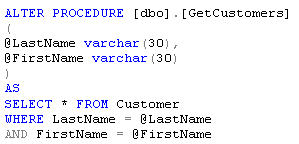
1.       You have original stored procedure
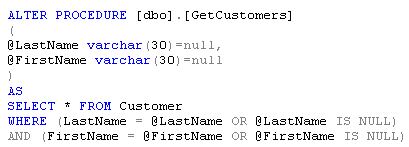
2.       Add =null at your parameter declaration of the stored procedure

3.       Add IS NULL at your WHERE clause
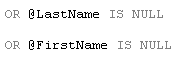
4.       Now you have optional parameters in the stored procedure
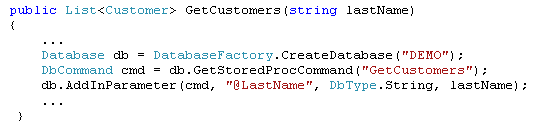
5.       Call the stored procedure from your data access layer C# code (FirstName is optional)
       
Published Monday, February 08, 2010 9:46 PM by StanleyGu
Filed under: , ,

Comments

# re: Solution 5 : Implementing Optional Parameters in T-SQL Stored Procedures

Monday, February 08, 2010 10:54 PM by Paul

Nice article but you can make your SQL faster by using COALESCE in the where clause:

WHERE LastName=COALESCE(@LastName,LastName) and FirstName = COALESCE(@FirstName,FirstName)

# re: Solution 5 : Implementing Optional Parameters in T-SQL Stored Procedures

Tuesday, February 09, 2010 12:20 AM by Thomas Tomiczek

No, you can not. Sorry to say, but learn the basics before making comments.

LastName = COALESCE (@LastName, LastName) should trigger a table scan because COALESCE (@LastName, LastName) must be evaluated for EVERY SINGLE LINE.

WHERE (LastName = @LastName OR @LastName IS NULL)

does not trigger this as you have EITHER a constant true on the right side (@LastName IS NULL) OR a constant false there and a simple expression that can utilize an index.

Beginner mistake. Well, at least you have the guts to put that into a public comment, Paul.

One thing seriously missing is the explanation of the HUGH downside unless one creates the stored procedure "with recompile" - which is that the FIRST run decides the execution plan, and that is being reused. If I pass in null = @LastName, soemthing in @FirstName on the first run, this decides the execution plan... also being used for something in @LastName, null in @FirstName.

To avoid this, the SP must be recompiled on every execution. Especially with something like given in this example this may be significant bad performance otherwise.

# re: Solution 5 : Implementing Optional Parameters in T-SQL Stored Procedures

Tuesday, February 09, 2010 1:01 PM by Thiago

Stanley,

I think that the problem on this solution is because when you use the statement ([LASTNAME] = @LASTNAME OR @LASTNAME IS NULL) in the WHERE clause and the column LASTNAME has a INDEX the SqlServer does not use the INDEX to improve performance on the query!

# links for 2010-02-09 « dstelow notes…

Tuesday, February 09, 2010 6:02 PM by links for 2010-02-09 « dstelow notes…

Pingback from  links for 2010-02-09 «  dstelow notes…

# re: Solution 5 : Implementing Optional Parameters in T-SQL Stored Procedures

Friday, February 19, 2010 1:56 AM by amsneuton

Well this is OK but one more interesting way to do so is use it like

WHERE LastName=ISNULL(@LastName,LastName)

and FirstName=ISNULL(@FirstName,FirstName)

# re: Solution 5 : Implementing Optional Parameters in T-SQL Stored Procedures

Monday, January 31, 2011 5:44 AM by sachin

helpful content related to <a href="www.mindstick.com/.../37dd5217-1856-418c-84af-a344fc353e0c Stored Procedure">stored procedure</a>

# re: Solution 5 : Implementing Optional Parameters in T-SQL Stored Procedures

Tuesday, February 08, 2011 3:42 PM by terapaks

Nice comment amsneuton exactly what solved my issue.  simple and succinct.  Made my day!

# re: Solution 5 : Implementing Optional Parameters in T-SQL Stored Procedures

Wednesday, May 18, 2011 2:27 PM by GeoffreyO

Hey Thomas Tomiczek, you strike me as a guy who knows a lot about SQL Server, and who also happens to be a jerk.  Congrats on the first one.  Work on the second.

# re: Solution 5 : Implementing Optional Parameters in T-SQL Stored Procedures

Tuesday, November 15, 2011 8:31 AM by prakash

how to write sql query withoptional parameter

Leave a Comment

(required) 
(required) 
(optional)
(required)