DotNetStories

A friend of mine was seeking some help regarding HTML tables
and JQuery. I have decided to write a few posts
demonstrating the various techniques I used with JQuery to
achieve the desired functionality.
Τhere are other posts in my blog regarding JQuery.You
can find them all
here.
We will demonstrate this with a step by step example. I will
use Visual Studio 2012 Ultimate. You can also use
Visual Studio 2012 Express Edition. You can also use VS 2010 editions.
1) Launch Visual Studio. Create an ASP.Net Empty Web application. Choose an appropriate name for your application.
2) Add a web form, default.aspx page to the
application.
3) Add a table from the HTML controls tab control (from the Toolbox) on the default.aspx page
4) Now we need to download the JQuery library. Please visit the http://jquery.com/ and download the minified version.
5) We will add a stylesheet to the application
(Style.css)
6) Obviously at some point we need to reference the JQuery
library and the external stylesheet. In the head section Ι add
the following lines.
   <link href="Style.css" rel="stylesheet" type="text/css" />

    <script src="jquery-1_8_2_min.js" type="text/javascript"></script>
7) Now we need to highlight the rows when the user hovers over them.
8) First we need to type the HTML markup
<body>
<form id="form1"
runat="server">
<div>
<h1>Liverpool Legends</h1>
<table style="width: 50%;" border="1"
cellpadding="10" cellspacing ="10">
<thead>
<tr><th>Defenders</th><th>MidFielders</th><th>Strikers</th></tr>
</thead>
<tbody>
<tr>
<td>Alan
Hansen</td>
<td>Graeme
Souness</td>
<td>Ian
Rush</td>
</tr>
<tr>
<td>Alan
Kennedy</td>
<td>Steven
Gerrard</td>
<td>Michael Owen</td>
</tr>
<tr>
<td>Jamie Garragher</td>
<td>Kenny Dalglish</td>
<td>Robbie Fowler</td>
</tr>
<tr>
<td>Rob Jones</td>
<td>Xabi Alonso</td>
<td>Dirk Kuyt</td>
</tr>
</tbody>
</table>
</div>
</form>
</body>
9) Now we need to write the simple rules in the style.css file.
body
{
background-color:#eaeaea;
}
.hover
{
background-color:#42709b;
color:#ff6a00;
}
10) Inside the head section we also
write the simple JQuery code.
     <script type="text/javascript">

        $(document).ready(function() {
            $('tr').hover(

               function() {
                   $(this).find('td').addClass('hover');
               },
                function() {
                    $(this).find('td').removeClass('hover');
                }
                );

        });


    </script>
11) Run your application and see the row changing background color and text color every time the user hovers over it.
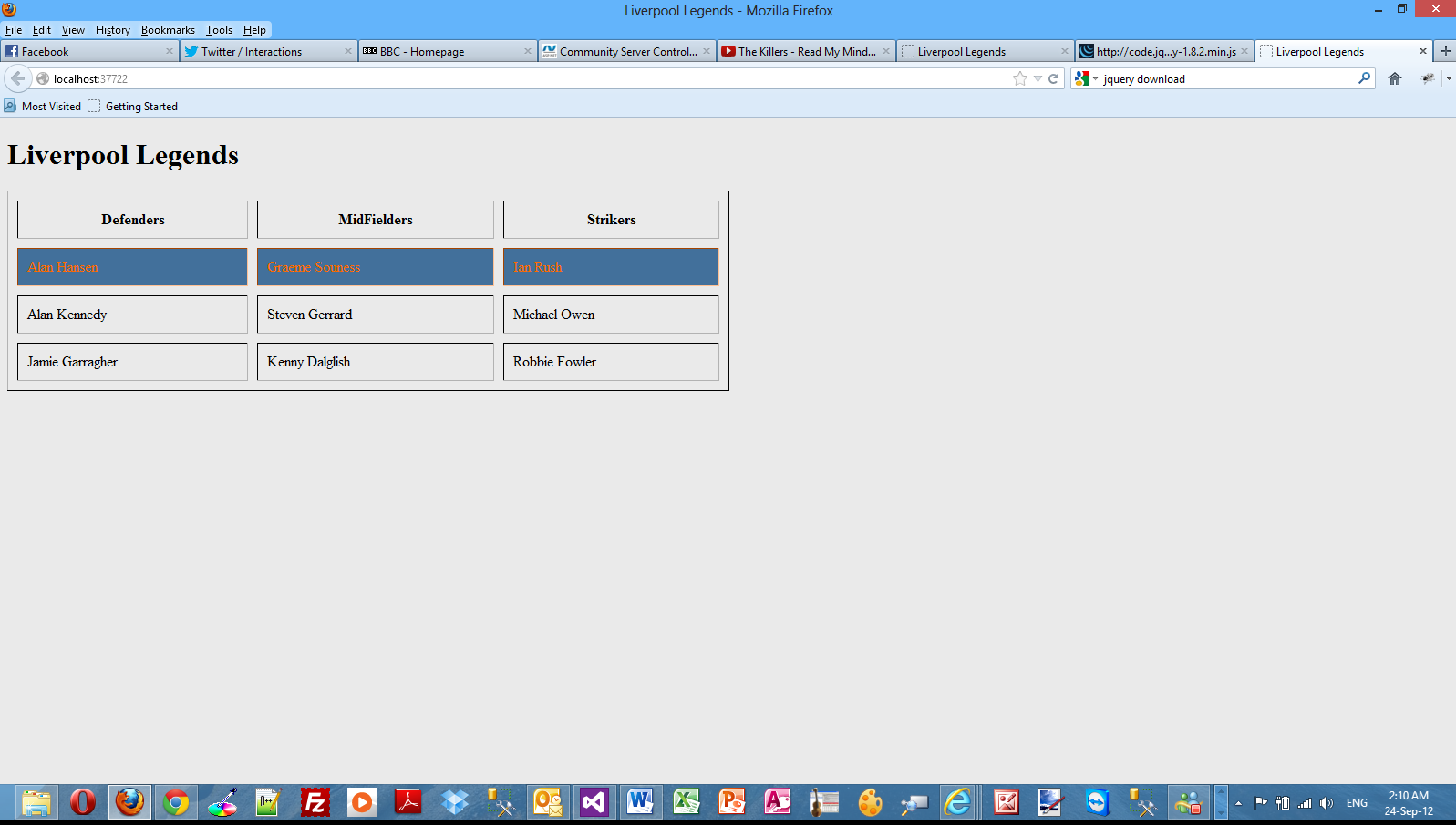
Let me explain how this functionality is achieved.We
have the .hover style rule in the
style.css file that contains some properties that
define the background color value and the color value
when the mouse will be hovered on the row.In the JQuery
code we do attach the hover() event to the
tr elements.The function that is called when the
hovering takes place, we search for the
td element and through the
addClass function we apply the styles defined in
the .hover class rule in the style.css file.I
remove the .hover rule styles with the
removeClass function.
Now let's say that we want to highlight only alternate rows of the table.We need to add another rule in the style.css
.alternate {
background-color:#42709b;
color:#ff6a00;
}
The JQuery code (comment out the previous JQuery code)
follows
<script type="text/javascript">
$(document).ready(function() {
$('table
tr:odd').addClass('alternate');
});
</script>
When I run my application through VS I see the following result

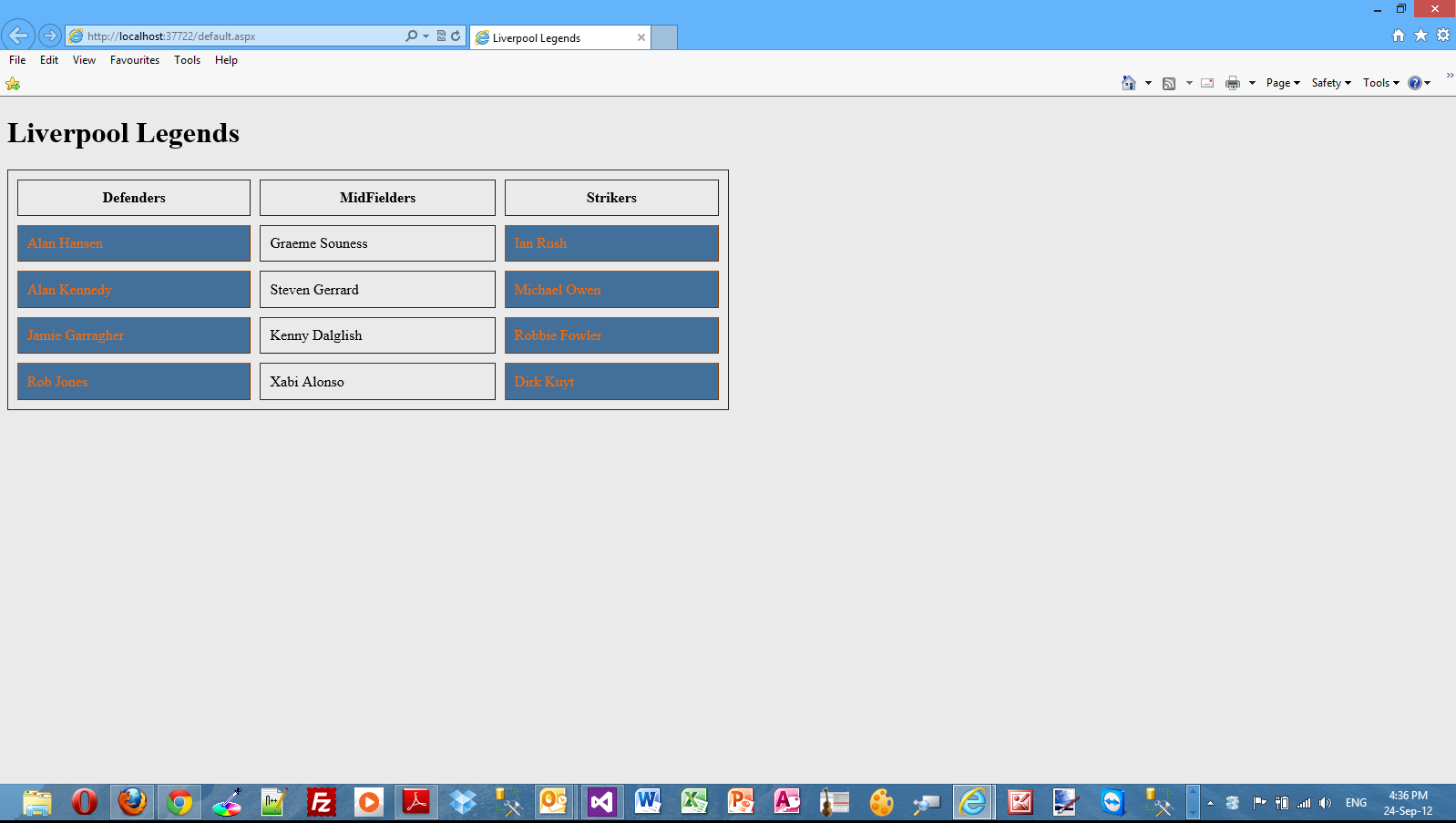
You can do that with columns as well. You can highlight alternate columns as well.
The JQuery code (comment out the previous JQuery code)
follows
<script type="text/javascript">
$(document).ready(function() {
$('td:nth-child(odd)').addClass('alternate');
});
</script>
In this script I use the nth-child() method in
the JQuery code.This method retrieves all the elements
that are nth children of their parent.
Have a look at the picture below to see the
results
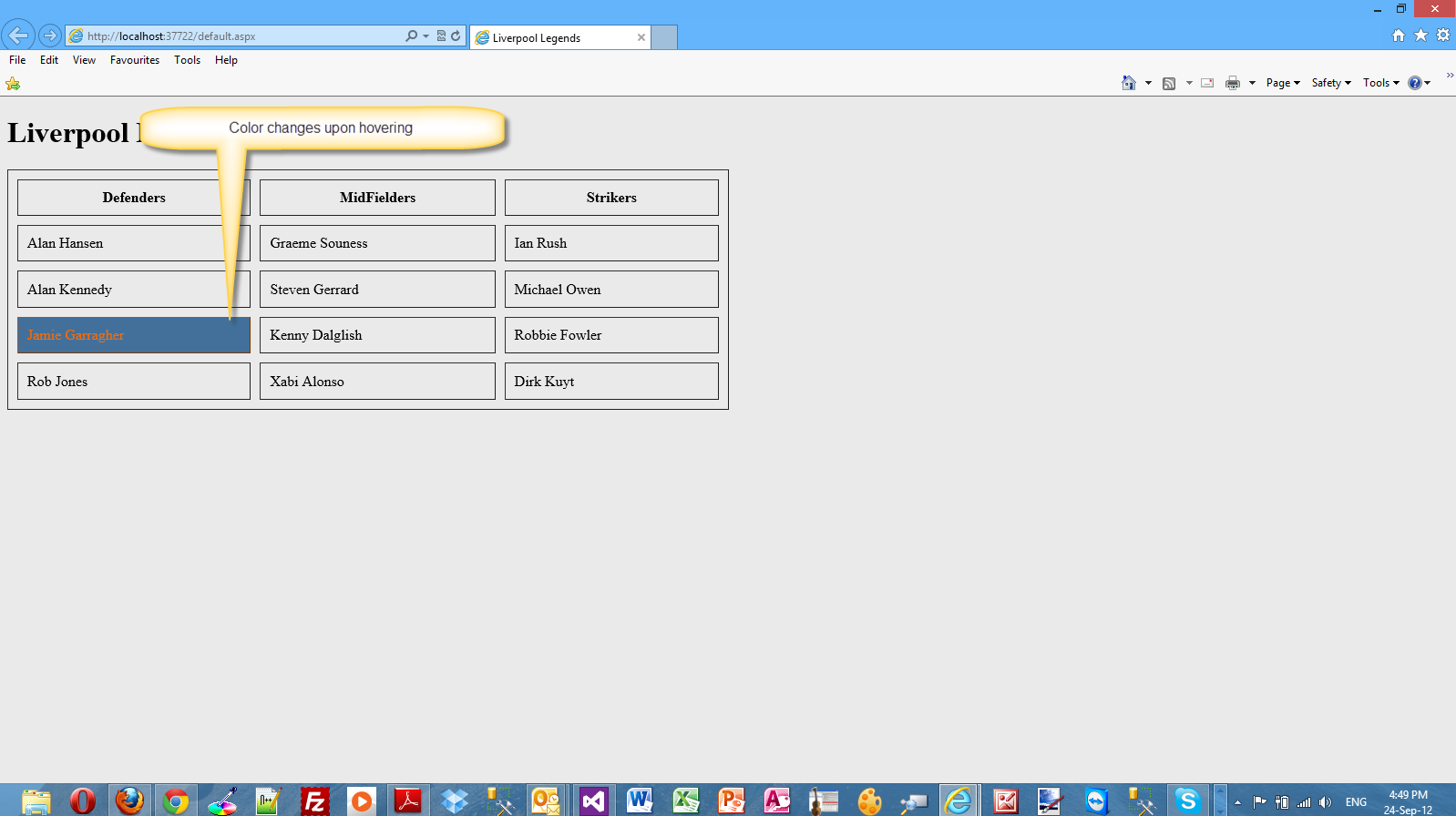
You can also change color to each individual cell when hovered on.
The JQuery code (comment out the previous JQuery
code) follows
<script type="text/javascript">
$(document).ready(function() {
$('td').hover(
function()
{
$(this).addClass('hover');
},
function() {
$(this).removeClass('hover');
}
);
});
</script>
Have a look at the picture below to see the results.
Hope it helps!!!
Comments have been disabled for this content.