Tales from the Evil Empire
Bertrand Le Roy's blog
-
Migrating an Orchard site from SqlCe to Sql Express using WebMatrix
In this short video, I show how to use WebMatrix to migrate an Orchard site from using the file-based SqlCe to a SQL Express database.
-
What happens when I request a page in Orchard?
 If you look at a typical request for a page, the
route will resolve the URL to the Display method of
the ItemController in
Orchard.Core/Routable/Controllers. That action will
retrieve the content item for that route from the
content manager and ask it to build the display. The
ShapeResult it will produce is what is returned by the
action.
If you look at a typical request for a page, the
route will resolve the URL to the Display method of
the ItemController in
Orchard.Core/Routable/Controllers. That action will
retrieve the content item for that route from the
content manager and ask it to build the display. The
ShapeResult it will produce is what is returned by the
action.
-
Taking over list rendering in Orchard
 A task that is likely to pop-up oftentimes when
customizing an Orchard theme for a project is list
rendering. Two types of shapes will typically be at
work when rendering a list in Orchard: the summary
shape and the list shape.
A task that is likely to pop-up oftentimes when
customizing an Orchard theme for a project is list
rendering. Two types of shapes will typically be at
work when rendering a list in Orchard: the summary
shape and the list shape.
-
Dispatching Orchard shapes to arbitrary zones
 In
my LIDNUG demo
last week, I showed an interesting technique that I
know some people will want to apply to their own
stuff.
In
my LIDNUG demo
last week, I showed an interesting technique that I
know some people will want to apply to their own
stuff.
-
Driving a LED matrix from a Netduino one more time: The Right Way
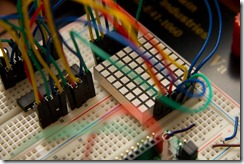 In previous posts, we've seen two ways one can drive
a small LED matrix from a
Netduino.
In previous posts, we've seen two ways one can drive
a small LED matrix from a
Netduino.
-
My Orchard talk for LIDNUG
 I just finished speaking at
LIDNUG. You can
download the recording here:
I just finished speaking at
LIDNUG. You can
download the recording here:
-
Dynamically switching the theme in Orchard
 It may sound a little puzzling at first, but in
Orchard CMS, more than one theme can be active at any
given time. The reason for that is that we have an
extensibility point that allows a module (or a theme)
to participate in the choice of the theme to use, for
each request. The motivation for building the theme
engine this way was to enable developers to switch
themes based on arbitrary criteria, such as user
preferences or the user agent (if you want to serve a
mobile theme for phones for example). The choice is
made between the active themes, which is why there is
a difference between the default theme and the active
themes.
It may sound a little puzzling at first, but in
Orchard CMS, more than one theme can be active at any
given time. The reason for that is that we have an
extensibility point that allows a module (or a theme)
to participate in the choice of the theme to use, for
each request. The motivation for building the theme
engine this way was to enable developers to switch
themes based on arbitrary criteria, such as user
preferences or the user agent (if you want to serve a
mobile theme for phones for example). The choice is
made between the active themes, which is why there is
a difference between the default theme and the active
themes.
-
The best way to learn how to extend Orchard
 We do have
tutorials on the Orchard site, but we can't cover all topics, and recently I've
found myself more and more responding to
forum questions
by pointing people to an existing module that was
solving a similar problem to the one the question was
about.
We do have
tutorials on the Orchard site, but we can't cover all topics, and recently I've
found myself more and more responding to
forum questions
by pointing people to an existing module that was
solving a similar problem to the one the question was
about.
-
Storing non-content data in Orchard
 A CMS like
Orchard
is, by definition, designed to store content. What
differentiates content from other kinds of data is
rather subtle. The way I would describe it is by
saying that if you would put each instance of a kind
of data on its own web page, if it would make sense to
add comments to it, or tags, or ratings, then it is
content and you can
store it in Orchard using all the convenient
composition options that it offers. Otherwise, it probably isn't and you can store it
using somewhat simpler means that I will now describe.
A CMS like
Orchard
is, by definition, designed to store content. What
differentiates content from other kinds of data is
rather subtle. The way I would describe it is by
saying that if you would put each instance of a kind
of data on its own web page, if it would make sense to
add comments to it, or tags, or ratings, then it is
content and you can
store it in Orchard using all the convenient
composition options that it offers. Otherwise, it probably isn't and you can store it
using somewhat simpler means that I will now describe.
-
Caching items in Orchard
 Orchard has its own caching API that while built on
top of ASP.NET's caching feature adds a couple of
interesting twists.
Orchard has its own caching API that while built on
top of ASP.NET's caching feature adds a couple of
interesting twists.