Contents tagged with Silverlight
-
Welcome 2012
Things that happened in 2011
- MIX11 was a good conference, but not as great as MIX11. I blogged about
-
The BUILD conference (here’s my
short recap) at first did a good job at exciting me about the
things to come. But then too many “oh, wait a minute,
so you’re saying …” moments hit me.
-
On both conferences
Microsoft didn’t do much to prevent Silverlight
from being labeled as “dead”. It’s a sad fact that we’re living in a world where
reality is reduced to 140 characters or less. It’s
just “good vs. evil”, “win vs. fail”, “the past vs.
the future”.
There was one sentence near the end of the “Standards-based web, plug-ins and Silverlight” blog post in April that did say the right thing: “HTML5 is a solution for many scenarios, but developers should make the appropriate choice based on application needs”. But the mismanaged communication by Microsoft, obviously caused by political in-fighting, puts this pragmatic “use the right tool for the right scenario” approach at risk. Why was Silverlight RC5 announced one week before BUILD? Why wasn’t the 10 year support guarantee communicated at BUILD (even if without a specific date)?
Other companies would have entered the stage with a loud and clear voice, telling everybody “Look at us, we’re the greatest development company in the world, we offer X and Y and Z.” – without showing the infamously silly architecture diagram.
- On a more positive note: The dotnet Cologne 2011, the conference organized by the .NET user group Köln and my own group Bonn-to-Code.Net became the largest .NET community conference in Germany with almost 330 attendees.
Things that I have learned/observed/noticed in 2011
-
I learned that I’m not the only one to have the
growing feeling of “less participation, more
consumption” in the (local) .NET community.
A discussion at the .NET Open Space 2011 in Karlsruhe brought up the word “consumity”. In Bonn, despite the success of the dotnet Cologne conferences, the core audience has remained virtually unchanged over the years; the majority is “cherry picking” specific topics and finding speakers from within the group is tough.
-
I (again) couldn’t decide on a new
smartphone
to replace my vintage XDA Neo. After comparing
Android, Windows Phone and iOS, I was ready to buy an
iPhone (for its available software), but the 4S kept
the design of the iPhone 4 which (in my humble
opinion) is cool to look at, but doesn’t feel good in
my hand. So one more year of being the only guy
without a “real” smartphone. On the other hand my
track record of waiting for a certain point in time to
buy a piece of technology hasn’t been too bad.
- I finally made the jump from Paint Shop Pro to Photoshop. Being a PSP user since 4.x, the transition – especially un-learning certain key strokes – wasn’t easy and there are still situations where I’d be faster in PSP. But of course I also gained a lot from the transition. And learning something different and trying to soak up a different philosophy from time to time isn’t a bad thing, either.
Things I’m looking forward to in 2012
-
The
dotnet Cologne 2012
on May 4th. We’ll be able to keep many sponsors from
last year, but we’re also looking for new sponsors.
Just drop me a line via the “Contact” link and we’ll
send you our information on sponsorship
opportunities.
-
A new version of Visual Studio, which I suspect/hope
to be more of a “Visual Studio 2010 R2” than something completely new.
-
Using async/await in C# in an RTM, i.e. non-CTP
environment.
- Continuing my personal path from being a software developer with an interest in GUIs to becoming a UI/UX expert.
-
Welcome 2011
Things that happened in 2010
-
MIX10 was absolutely fantastic. Read
my report of MIX10
to see why.
-
The
dotnet Cologne 2010, the community conference organized by the
.NET user group Köln
and my own group
Bonn-to-Code.Net
became an even bigger success than I dared to dream
of.
-
There was a huge discrepancy between the efforts by
Microsoft to support .NET user groups to organize
public live streaming events of the PDC
keynote
(the dotnet Cologne team joined forces with
netug Niederrhein
to organize the
PDCologne) and the actual content of the keynote. The reaction
of the audience at our event was “meh” and even worse
I seriously doubt we’ll ever get that number of people
to such an event (which on top of that suffered from
technical difficulties beyond our control).
- What definitely would have deserved the public live streaming event treatment was the Silverlight Firestarter (aka “Silverlight Damage Control”) event. And maybe we would have thought about organizing something if it weren’t for the “burned earth” left by the PDC keynote. Anyway, the stuff shown at the firestarter keynote was the topic of conversations among colleagues days later (“did you see that? oh yeah, that was seriously cool”).
Things that I have learned/observed/noticed in 2010
-
In the long run, there’s a huge difference between “It
works pretty well” and “it just works and I never have
to think about it”. I had to get rid of my USB
graphics adapter powering the third monitor (read
about it in
this blog post). Various small issues (desktop icons
sometimes moving their positions after a
reboot for no apparent reasons, at least one game I
couldn’t get run at all, all three monitors
sometimes simply refusing to wake up after
standby) finally made me buy a PCIe 1x graphics
adapter. If you’re interested: The combination of a
NVIDIA GTX 460 and a GT 220 is running in “don’t make
me think” mode for a couple of months now.
-
PowerPoint 2010 is a seriously cool
piece of software. Not only the new
hardware-accelerated effects, but also features like
built-in background removal and picture processing
(which in many cases are simply “good enough” and save
a lot of time) or the smart guides.
-
Outlook 2010 crashes on me a lot. I
haven’t been successful in reproducing these crashes,
they just happen when every couple of days on
different occasions (only thing in common: I clicked
something in the main window – yeah, very helpful
observation)
-
Visual Studio 2010 reminds me of
Visual Studio 2005 before SP1, which is actually not a
good thing to say about a piece of software. I think
it’s telling that Microsoft’s message regarding the
beta of SP1 has been different from earlier service
pack betas (promising an upgrade path for a beta to
the RTM sounds to me like “please, please use it
NOW!”).
- I have a love/hate relationship with ReSharper. I don’t want to develop without it, but at the same time I can’t fail to notice that ReSharper is taking a heavy toll in terms of performance and sometimes stability.
Things I’m looking forward to in 2011
-
Obviously, the
dotnet Cologne 2011. We already have been able to score some big name
sponsors (Microsoft, Intel), but
we’re still looking for more sponsors. And be assured that we’ll make sure that our
partners get the most out of their contribution,
regardless of how big or small.
- MIX11, period.
- Silverlight 5 is going to be great. The only thing I’m a bit nervous about is that I still haven’t read anything official on whether C# next version’s async/await will be in it. Leaving that out would be really stupid considering the end-of-2011 release of SL5 (moving the next release way into the future).
-
MIX10 was absolutely fantastic. Read
my report of MIX10
to see why.
-
Looking Back at MIX10
It’s the sad truth of my life that even though I’m fascinated by airplanes and flight in general since my childhood days, my body doesn’t like flying. Even the ridiculously short flights inside Germany are taking their toll on me each time.
Now combine this with sitting in the cramped space of economy class for many hours on a transatlantic flight from Germany to Las Vegas and back, and factor in some heavy dose of jet lag (especially on my way eastwards), and you get an idea why after coming back home I had this question on my mind:
Was it really worth it to attend MIX10?
This of course is a question that will also be asked by my boss at Comma Soft (for other reasons, obviously), who decided to send me and my colleague Jens Schaller, to the MIX10 conference. (A note to my German readers: An dieser Stelle der Hinweis, dass Comma Soft noch Silverlight-Entwickler und/oder UI-Designer für den Standort Bonn sucht – aussagekräftige Bewerbungen bitte an Herausforderung@comma-soft.com)
Too keep things short: My answer is yes.
Before I’ll go into detail, let me ask the heretical questions whether tech conferences in general still make sense.
There was a time, where actually being at a tech conference gave you a head-start in regard to learning about new technologies. Nowadays this is no longer true, where every bit of information and every detail is immediately twittered, blogged and whatevered to death. In the case of MIX10 you even can download the video-taped sessions shortly after.
So: Does visiting a conference still make sense? It depends on what you expect from a conference. It should be clear to everybody that you’ll neither get exclusive information, nor receive training in a small group.
What a conference does offer that sitting in front of your computer does not can be summarized as follows:
-
Focus
Being away from work and home will help you to focus on the presented information. Of course there are always the poor guys who are haunted by their work (with mails and short text messages reporting the latest showstopper problem), but in general being out of your office makes a huge difference.
-
Inspiration
With the focus comes the emotional involvement. I find it much easier to absorb information if I feel that certain vibe when sitting in a session. This still means that I have put work into reviewing the information later, but it’s a better starting point. And all the impressions collected at a (good) conference combined lead to a higher motivation – be it by the buzz (“this is gonna be sooo cool!”) or by the fear to fall behind (“man, we’ll have work on this, or else…”).
-
People
At a conference it’s pretty easy to get into contact with other people during breakfast, lunch and other breaks. This is a good opportunity to get a feel for what other development teams are doing (on a very general level of course, nobody will tell you about their secret formula) and what they are thinking about specific technologies.
So MIX10 did offer focus, inspiration and people, but that would have meant nothing without valuable content.
When I (being a frontend developer with a strong interest in UI/UX) planned my visit to MIX10, I made the decision to focus on the "soft" topics of design, interaction and user experience. I figured that I would be bombarded with all the technical details about Silverlight 4 anyway in the weeks and months to come.
Actually, I would have liked to catch a few technical sessions, but the agenda wasn’t exactly in favor of people interested in any kind of Silverlight and UI/UX/Design topics. That’s one of my few complaints about the conference – I would have liked one more day and/or more sessions per day.
Overall, the quality of the workshops and sessions was pretty high. In fact, looking back at my collection of conferences I’ve visited in the past I’d say that MIX10 ranks somewhere near the top spot.
Here’s an overview of the workshops/sessions I attended (I’ll leave out the keynotes):
Day 0 (Workshops on Sunday)
-
Design Fundamentals for Developers
Robby Ingebretsen is the man! Great workshop in three parts with the perfect mix of examples, well-structured definition of terminology and the right dose of humor. Robby was part of the WPF team before founding his own company so he not only has a strong interest in design (and the skillz!) but also the technical background.
-
Design Tools and Techniques
Originally announced to be held by Arturo Toledo, the Rosso brothers from ArcheType filled in for the first two parts, and Corrina Black had a pretty general part about the Windows Phone UI. The first two thirds were a mixed bag; the two guys definitely knew what they were talking about, and the demos were great, but the talk lacked the preparation and polish of a truly great presentation.
Corrina was not allowed to go into too much detail before the keynote on Monday, but the session was still very interesting as it showed how much thought went into the Windows Phone UI (and there’s always a lot to learn when people talk about their thought process).
Day 1 (Monday)
-
Designing Rich Experiences for Data-Centric
Applications
I wonder whether there was ever a test-run for this session, but what Ken Azuma and Yoshihiro Saito delivered in the first 15 minutes of a 30-minutes-session made me walk out. A commercial for a product (just great: a video showing a SharePoint plug-in in an all-Japanese UI) combined with the most generic blah blah one could imagine. EPIC FAIL.
-
Great User Experiences: Seamlessly Blending
Technology & Design
I switched to this session from the one above but I guess I missed the interesting part – what I did catch was what looked like a “look at the cool stuff we did” without being helpful. Or maybe I was just in a bad mood after the other session.
-
The Art, Technology and Science of Reading
This talk by Kevin Larson was very interesting, but was more a presentation of what Microsoft is doing in research (pretty impressive) and in the end lacked a bit the helpful advice one could have hoped for.
-
10 Ways to Attack a Design Problem and Come Out
Winning
Robby Ingebretsen again, and again a great mix of theory and practice. The clean and simple, yet effective, UI of the reader app resulted in a simultaneous “wow” of Jens and me. If you’d watch only one session video, this should be it. Microsoft has to bring Robby back next year!
Day 2 (Tuesday)
-
Touch in Public: Multi-touch Interaction Design
for Kiosks & Architectural Experiences
Very interesting session by Jason Brush, a great inspiration with many details to look out for in the examples. Exactly what I was hoping for – and then some!
-
Designing Bing: Heart and Science
How hard can it be to design the UI for a search engine? An input field and a list of results, that should be it, right? Well, not so fast! The talk by Paul Ray showed the many iterations to finally get it right (up to the choice of a specific blue for the links). And yes, I want an eye-tracking device to play around with!
-
The Elephant in the Room
When Nishant Kothary presented a long list of what his session was not about, I told to myself (not having the description text present) “Am I in the wrong talk? Should I leave?”. Boy, was I wrong. A great talk about human factors in the process of designing stuff.
-
An Hour with Bill Buxton
Having seen Bill Buxton’s presentation in the keynote, I just had to see this man again – even though I didn’t know what to expect. Being more or less unplanned and intended to be more of a conversation, the session didn’t provide a wealth of immediately useful information. Nevertheless Bill Buxton was impressive with his huge knowledge of seemingly everything. But this could/should have been a session some when in the evening and not in parallel to at least two other interesting talks.
Day 3 (Wednesday)
-
Design the Ordinary, Like the Fixie
This session by DL Byron and Kevin Tamura started really well and brought across the message to keep things simple. But towards the end the talk lost some of its steam. And, as a member of the audience pointed out, they kind of ignored their own advice when they used a fancy presentation software other then PowerPoint that sometimes got in the way of showing things.
-
Developing Natural User Interfaces
Speaking of alternative presentation software, Joshua Blake definitely had the most remarkable alternative to PowerPoint, a self-written program called NaturalShow that was controlled using multi-touch on a touch screen. Not a PowerPoint-killer, but impressive nevertheless. The (excellent) talk itself was kind of eye-opening in regard to what “multi-touch support” on various platforms (WPF, Silverlight, Windows Phone) actually means.
-
Treat your Content Right
The talk by Tiffani Jones Brown wasn’t even on my planned schedule, but somehow I ended up in that session – and it was great. And even for people who don’t necessarily have to write content for websites, some points made by Tiffani are valid in many places, notably wherever you put texts with more than a single word into your UI.
-
Creating Effective Info Viz in Microsoft
Silverlight
The last session of MIX10 I attended was kind of disappointing. At first things were very promising, with Matthias Shapiro giving a brief but well-structured introduction to info graphics and interactive visualizations. Then the live-coding began and while the result was interesting, too much time was spend on wrestling to get the code working. Ending earlier than planned, the talk was a bit light on actual content, but at least it included a nice list of resources.
Conclusion
It could be felt all across MIX10, UIs will take a huge leap forward; in fact, there are enough examples that have already. People who both have the technical know-how and at least a basic understanding of design (“literacy” as Bill Buxton called it) are in high demand. The concept of the MIX conference and initiatives like design.toolbox shows that Microsoft understands very well that frontend developers have to acquire new knowledge besides knowing how to hack code and putting buttons on a form.
There are extremely exciting times before us, with lots of opportunity for those who are eager to develop their skills, that is for sure.
-
Focus
-
Computer Books to Read on a Lonely Island
I recently had the pleasure to visit this place:

On an island of approx 300x200 meters, snorkeling, swimming, eating, sleeping and relaxing is pretty much all you do. And reading, lots of reading:
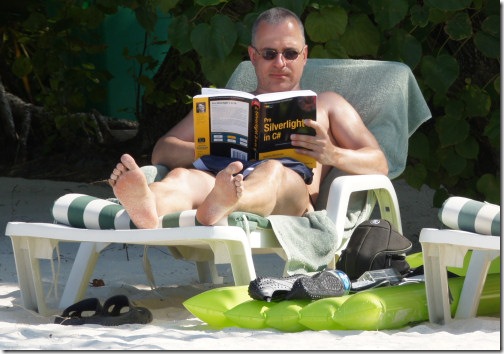
Two [computer] books that passed my personal “good to read far away from the keyboard” test are:
-
“Clean Code: A Handbook of Agile Software
Craftsmanship”
Robert C. Martin
I had this on my bookshelf for quite some time, but never did more than quickly scan the chapters. When you talk to people who have read this book, they usually say “you will not agree on everything the book says, but it is an important book to read” – now I’m one of them.
I won’t go into more detail here; the reviews on e.g. Amazon pretty much capture what this book is about, so I recommend you take a look there.
-
“Pro Silverlight 3 in C#”
Matthew MacDonald
Unlike “Clean Code”, this may not a book that would come to one’s mind as something that could be read well away from the computer – after all, it’s dealing with a specific technology and not general concepts.
But this book does the walkthrough through the various code samples so well that you don’t need Visual Studio to follow what’s going on. I never had the feeling “Wait, where does this thing come from? If I only could hit F12” (which was what happened to me with one of the early books on WPF).
-
“Clean Code: A Handbook of Agile Software
Craftsmanship”